Al-Maʾmūn and His Astronomers
In the medieval Islamic world, there were many rulers who had a strong engagement with the science of stars. Among them, al-Maʾmūn ʿAbd Allāh ibn Hārūn al-Rashīd (r. 813-833), the seventh Abbasid caliph, is one of the most famous. Ḥabash al-Ḥāsib (fl. c. 835), a prominent mathematician and astronomer of his time who was a contemporary of al-Maʾmūn, stated in the preface to his book of astronomical tables:
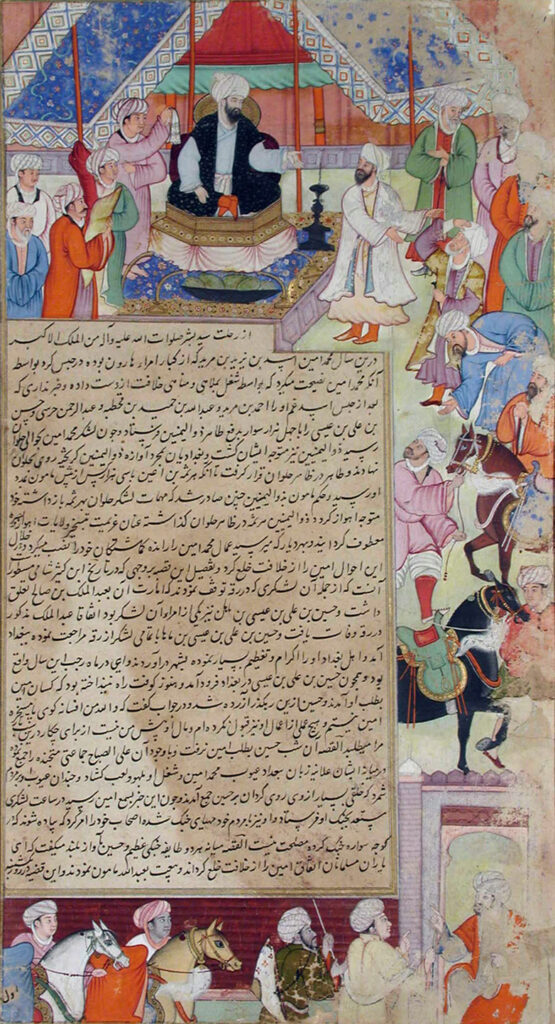
Date: ca. 1593
Credit Line: Edwin Binney 3rd Collection Accession Number: 1990.291
Collection: The San Diego Museum of Art
Al-Maʾmūn and Astronomy
Al-Maʾmūn was enthralled by the science of astronomy. He compared what he found in the astronomical works written by Greeks, such as the astronomical tables (produced probably by Theon and Ptolemy), to what he found belonging to Indians, and to the astronomical tables belonging to Persians. He noted that they are different in some respects. Each of them is correct in some cases and incorrect in some others. When he realized this, he ordered Yaḥyá ibn Abī Manṣūr to go back to the origins of the books on astronomy, and to gather the scientists who were well-versed in that art as well as the scholars from his time to collaborate on investigating the principles of this science and correcting it.
Ptolemy’s Almagest and Al-Maʾmūn
Yaḥyá followed al-Maʾmūn’s command and gathered scholars of the science of astronomy. They then turned their attention to the origins of these books. They thoroughly examined and compared the contents of these books. Among all these works, they found Ptolemy’s book called the Almagest to be the most accurate. This was due to the fact that Ptolemy in this book determined his methods for obtaining the correct results through clear measurements and geometrical proofs. They therefore regarded the Almagest as a canon for themselves. They then constructed observational instruments such as the armillary sphere and others, and in their observations, they followed the methods recorded by Ptolemy and examined the paths of the Sun and the Moon on different occasions in Baghdad.
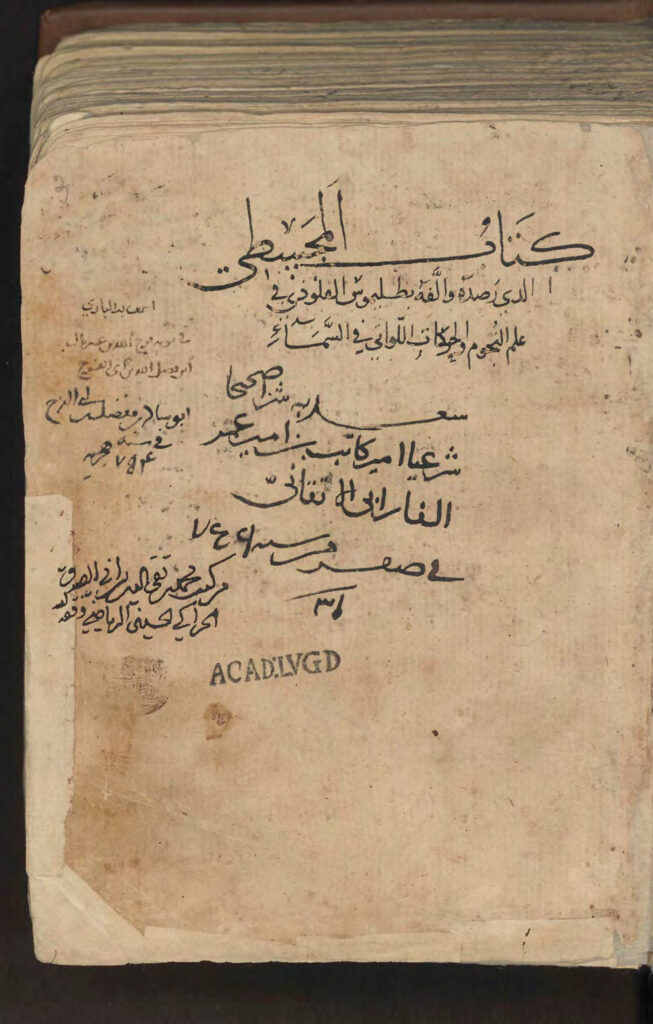
The title page of Ptolemy’s Almagest translated into Arabic by Ḥajjāj ibn Yūsuf ibn Maṭar for al-Maʾmūn. MS Netherlands, Leiden, Universiteit Leiden, Or, 680
Al-Maʾmūn’s Observatories
Al-Maʾmūn also constructed several observatories in Baghdad and Damascus to examine the motion of celestial objects. Based on historical records, al-Maʾmūn first commissioned the construction of an observatory in Baghdad under the supervision of Yaḥyá ibn Abī Manṣūr. Many other astronomers are listed as people who participated in this observational project, including Muḥammad ibn Mūsá al-Khwārazmī, Sanad ibn ʿAlī, and ʿAbbās ibn Saʿīd al-Jawharī. After Yaḥyá’s death, al-Maʾmūn asked Khālid ibn ʿAbd al-Malik al-Marwrūdhī to conduct another observational project, this time in Damascus. During these two phases of observational activities, several huge observational instruments were constructed.
Al-Maʾmūn not only supported scientific activities but also personally engaged in them, indicating his deep interest in the subject. Ḥabash in a different treatise in which he reported some of the observational activities under al-Maʾmūn’s patronage, tells us that when Khālid was constructing his instruments in Damascus, he noticed that the calibration of the instruments is sensitive to the change of temperature during a day. He reported this to al-Maʾmūn. al-Maʾmūn decided to examine this himself, thus he went to the observatory and tested the instruments himself. This clearly indicates that al-Maʾmūn was closely engaged with the details of observations conducted under his patronage.
Al-Maʾmūn’s Legacy
Based on the activities under al-Maʾmūn’s patronage, many astronomical works were produced including several sets of astronomical tables. In addition to this, al-Maʾmūn had a special interest in measuring the circumference of the Earth. So, he commissioned a group of scholars to measure it based on a method known as Eratosthenes’ method. The basic idea in this method is that if someone moves along a meridian circle observing the change in the altitude of Polaris, this change corresponds the distance he traversed on the surface of the Earth. The result of the measurement of al-Maʾmūn’s scholars is reported in several historical sources.
This article is contributed by Sajjad Nikfahm Khubravan