The History of Numbers
The numerals 0, 1, 2, 3, …, 9 and place-value numeration system were handed to Europeans since the 10th century through Arabic writings produced in Medieval Islamic Spain (historically known as “Andalus”). The form of these numerals is sometimes referred to as “dust numerals” (al-arqām al-ghubāriyya in Arabic). This naming originates from using dust boards for calculating based on the place-value system of numerals. The form of these numerals varied in different regions of Islamic world and changed over time.
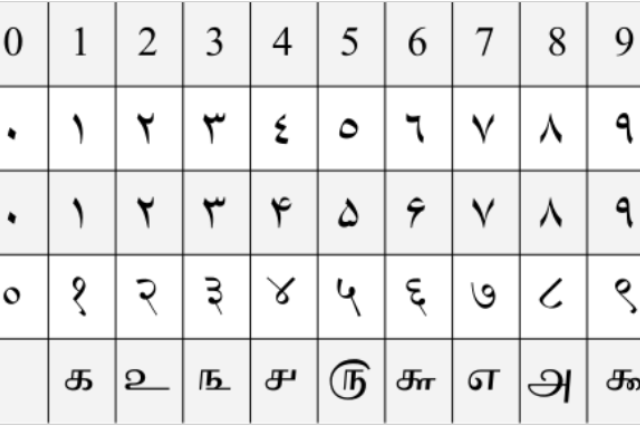
In the east of Islamic world, for example, a different set of symbols was used that was referred to, sometimes, as “Indian numerals” (al-arqām al-Hindiyya in Arabic). The word “Indian” here indicates where the place-value numeration system was invented first: from the extant ancient Sanskrit mathematical works and from references found in Arabic works, we know that Indians invented this system. The Indians developed a set of nine symbols to represent all numbers, to which, later, they added a symbol for zero. This system found its path to the Islamic world through different channels. Sassanid mathematics and astronomy were heavily influenced by the contributions made by Indians.
After the rise of Islam, the Sassanid scientific corpus was translated into Arabic. This made parts of Indians’ contributions accessible to scholars in Islamic world. Moreover, many Sanskrit sources were directly translated into Arabic. As early as the 9th century, mathematicians produced works in Arabic describing the arithmetical operations using the numerals they had received from Indians.
This article is contributed by Sajjad Nikfahm Khubravan