Maragha Observatory
In 1260 CE, one of the most ambitious astronomical projects of the Middle Ages started in the city Maragha under the supervision of the polymath Naṣīr al-Dīn al-Ṭūsī (d. 1274) and the sponsorship of the Mongol rulers of Persia (the Ilkhanids). The project aimed at building an observatory complex, at the top of a hill beside the city, that included the most advanced observational instruments of the time.
The Beginning of Maragha Observatory
Ṭūsī invited many scholars from all around the territory, including Muʾayyid al-Dīn al-ʿUrḍī (d. 1266) who became the architect of the observatory and the designer of its instruments.

Naṣīr al-Dīn al-Ṭūsī in his preface to Zīj Īlkhānī mentioned the name of his colleagues in the Maragha observatory: Muʾayyid al-Dīn al-ʿUrḍī (d. 1266) from Damascus, Fakhr al-Dīn al-Marāghī (d. 1268) from Mosul, Fakhr al-Dīn al-Akhlāṭī (d. 1281) from Tiblisi, and Najm al-Dīn Dabīrān al-Kātibī (d. 1276) from Qazvin. Image taken from: MS Turkey, Istanbul, Topkapı Saray Müzesi Kütüphanesi, Ahmet III, 3513
Muʾayyid al-Dīn al-ʿUrḍī described the astronomical instruments constructed in Maragha in a book written in Arabic. Archeological excavations have confirmed that these instruments were made at the observatory site, the largest of which reached 20 meters in height.
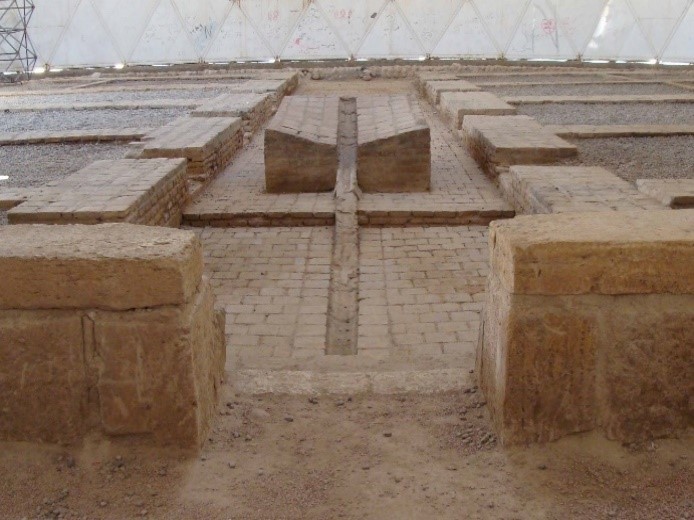
The remnants of the Maragha
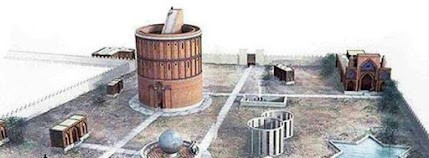
The reconstructed model of the Maragha observatory based on archeological excavation of Parviz Varjavand
Maragha Observatory’s Era
The presence of hundreds of scholars in Maragha made the city a center of intellectual activity in Ilkhanid territory, and thus encouraged people to go there to study all branches of sciences, including mathematics, astronomy, medicine, logic, and philosophy. Historical sources report many schools and libraries that were active in and around the observatory. This continued at least until the year of Ṭūsī’s death in 1274 CE, in which a collection of astronomical tables was realized under the title Zīj-i Īlkhānī (meaning “Ilkhanid tables”).
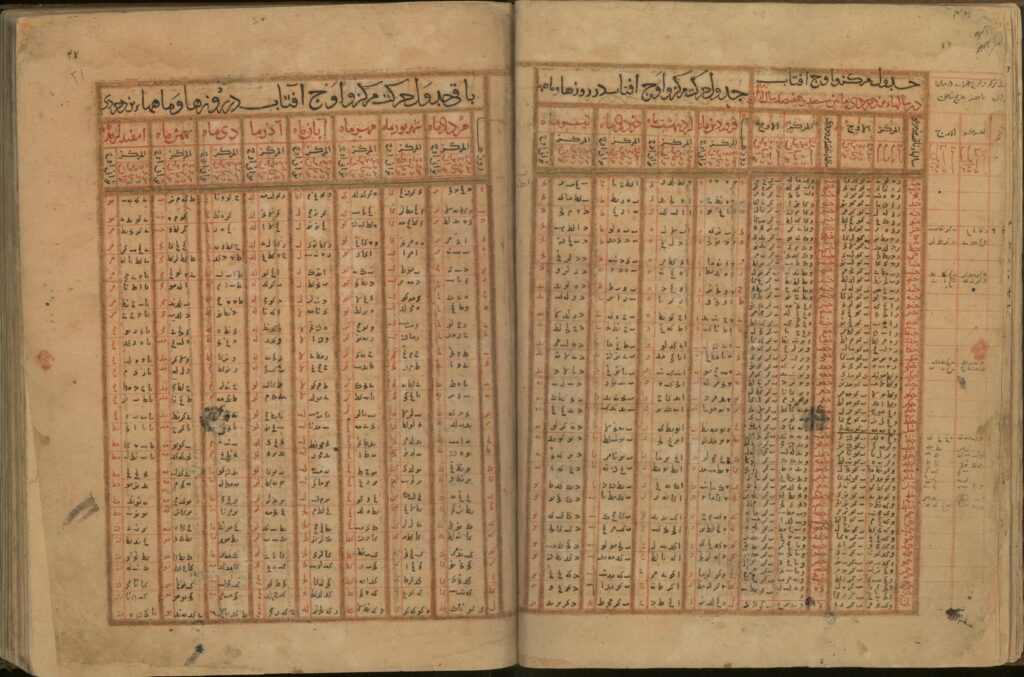
Two pages from Zīj-i Īlkhānī, MS Iran, Tehran, Kitābḫāna-yi Majlis-i Shūrā-yi Islāmī, Shūrā, 181
Zīj is a title for a genre of astronomical writings that included a series of astronomical and mathematical tables with instructions for how to use them. Some of the items typically found in Zījes are: trigonometrical tables, tables for different spherical astronomy functions, geographical coordinates of localities, planetary mean motion tables, tables of planetary equations, and tables and instructions for converting different calendars.
This article is contributed by Sajjad Nikfahm Khubravan