The Observers of the Middle Ages
The Middle Ages spanned from the fifth to the fifteenth centuries and witnessed the widespread popularity of astronomy across many geographical regions, including south Asia, Persia, north Africa, and Europe. However, it was during the glorious era of the Islamic world that the most advanced scientific activities of the time occurred. Scholars from this period engaged in various aspects of the science of stars, from theoretical and observational studies. While many dedicated their studies to practical parts of astronomy, including chronology, calendars, timekeeping, and mathematical geography, others focused on observations and making observational instruments. In this series of articles, we will discuss the most important observational activities of the Middle Ages.
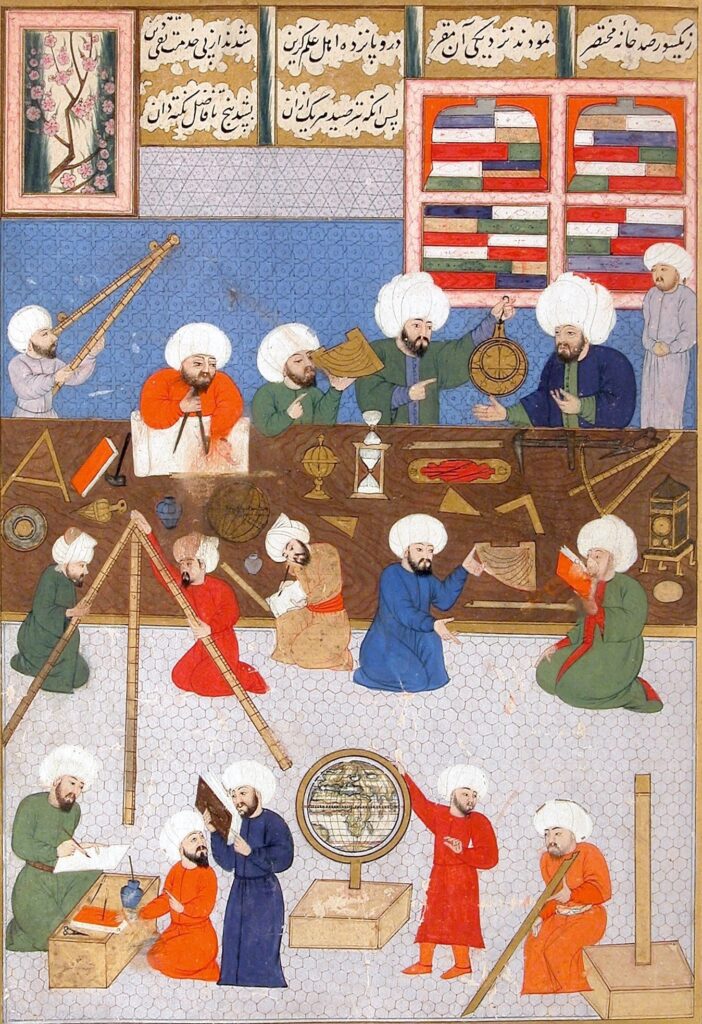
اردو: رصدگاۂ استنبول میں عثمانیہ فلکیاتدان تقی الدين کے ہمراہ کام کر رہے ہیں۔
Date: between circa 1574 and circa 1595
Source: Istanbul University Library, F 1404, fol. 57a (Ṣehinṣename, Book of the King of Kings).
Author: Ala ad-Din Mansur-Shirazi
During this period, many texts were translated and transmitted between different cultures, and people became universally influential in the history of astronomy. For example, the astronomical work of al-Battānī, one of the most important observers of the Middle Ages, was translated from Arabic into Latin and thus became influential both in the Islamic world and Europe. In addition to this, some of the observational activities during this period inspired scholars from other geographical regions to pursue their studies in the science of stars. An example of such activity is the establishment of a huge observatory in Samarqand that inspired the establishment of observatories in India and Europe. This influence is apparent both in the form of astronomical activities and in technical details. For example, the advancement in construction of observational instruments made its way from the Islamic world to Europe. Our goal in this series of articles is not to provide a comprehensive history of astronomy but to draw the attention of our readers to some of the most advanced observational activities of the Middle Ages.
This article is contributed by Sajjad Nikfahm Khubravan