Ptolemy’s Contributions
Ptolemy was the most influential astronomer in ancient and medieval times. His influence stems from his use of empiricism as the basis of his investigation into celestial motions. The characteristic feature of Ptolemy’s planetary theory was arrived at by an exceedingly ingenious analysis of planetary motions. While certain aspects of his astronomy were criticized and improved over time, these developments would not have been possible without Ptolemy’s initial work in describing celestial motions. That is why his solution has been described occasionally as the best possible description of planetary motion, prior to the discoveries of Kepler nearly fifteen hundred years later.

Ptolemy’s Almagest
Claudius Ptolemy wrote on every branch of mathematics as it was known in his time. Today, his major astronomical work is known as the Almagest. This title originated from the Arabized version of part of its Greek title. The Almagest details observations he conducted between 127 and 141 CE in Alexandria, the principal city of Greco-Roman Egypt.
Instruments in Ptolemy’s Almagest
In the Almagest, Ptolemy introduced several observational instruments. One such instrument is a bronze ring installed perpendicularly on the horizon and in the surface of the meridian circle at the observation location. The circumference of the instrument is divided into 360 degrees. He says that depending on the size of the ring, each degree of circumference can be divided into smaller calibration.
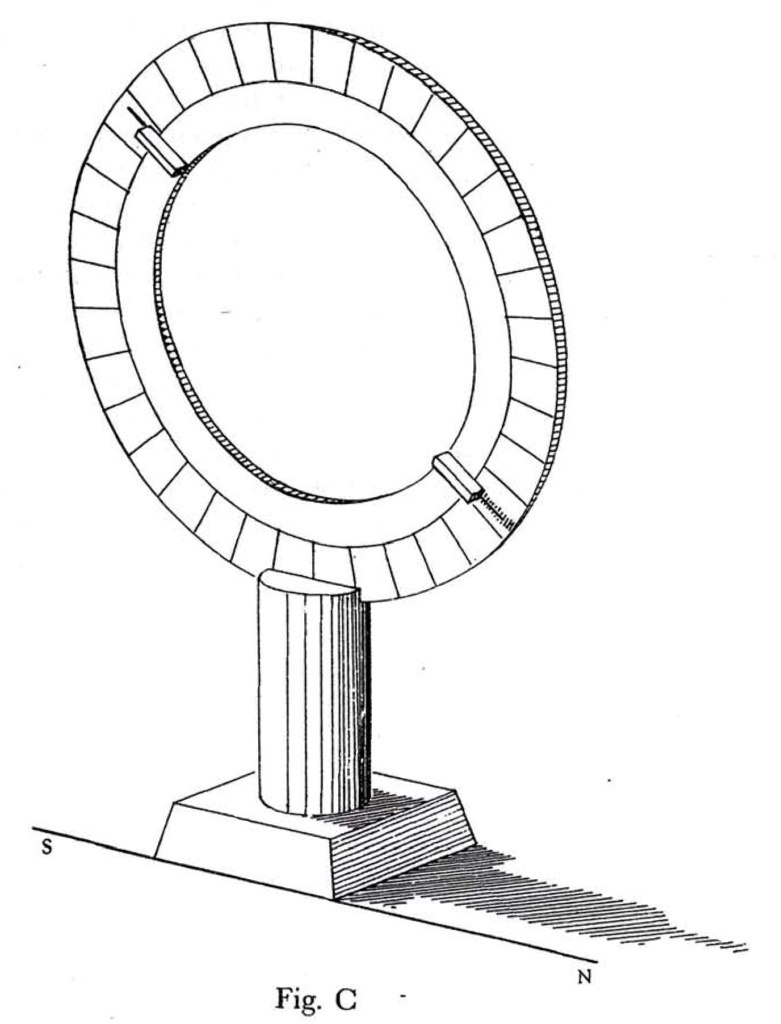
figure adopted from: G. J. Toomer. Ptolemy’s Almagest. P. 61
This simple instrument was used by Ptolemy to measure the solar altitude at its meridian passage. By measuring the altitude of the Sun around the solstices and determining its maximum and minimum altitude over the course of a year, Ptolemy could calculate the geographic latitude of a given location and inclination of the ecliptic to the equator. These two parameters were fundamental for practical astronomical calculations.
For conducting the very same kind of observations, Ptolemy introduces yet another instrument in the Almagest. This instrument is a square plaque made of stone or wood. On the surface of this plaque a quadrant is traced. The arc on this quadrant is calibrated into 90 degrees (and possibly into more subdivisions).
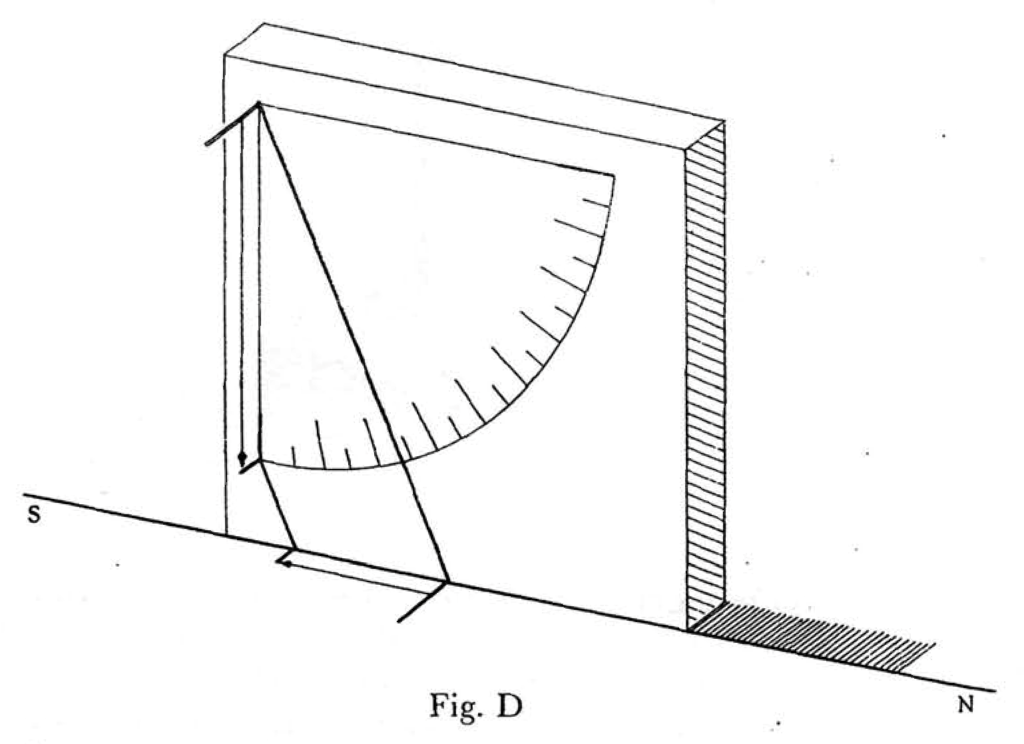
figure adopted from: G. J. Toomer. Ptolemy’s Almagest. P. 62
For measuring very small angles of lunar parallax, Ptolemy introduces a different type of instrument. Parallax refers to the apparent displacement of the Moon against the background of stars due to changes in the observer’s location on Earth and in the Moon’s altitude. This parallactic instrument is made of two rods attached to each other such that one of them can rotate freely around an axis attached to the other fixed rod. A central line is traced on the fixed rod and calibrated into 60 parts (and more subdivisions as needed). The fixed rod is erected perpendicularly on the horizon. On the moving rod two plates are installed parallel to each other and perpendicular to the body of the rod. These plates have holes in them through which the Moon can be observed.
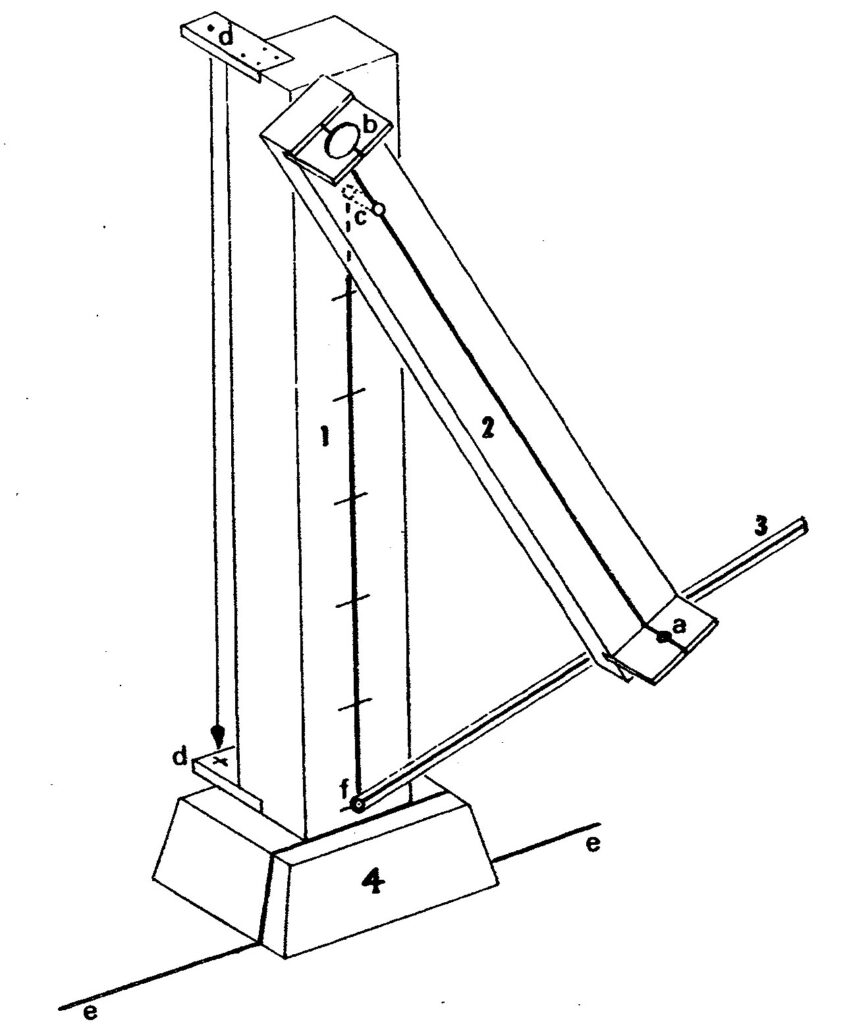
figure adopted from: G. J. Toomer. Ptolemy’s Almagest. P. 245.
In the Almagest, Ptolemy also introduces an armillary sphere. Armillary sphere is a simulation and observational instrument constituted of seven rings each representing one of the basic spherical astronomy circles. These include ecliptic, equator, colure (a circle passing the poles of the ecliptic and the equator), and latitude circle.
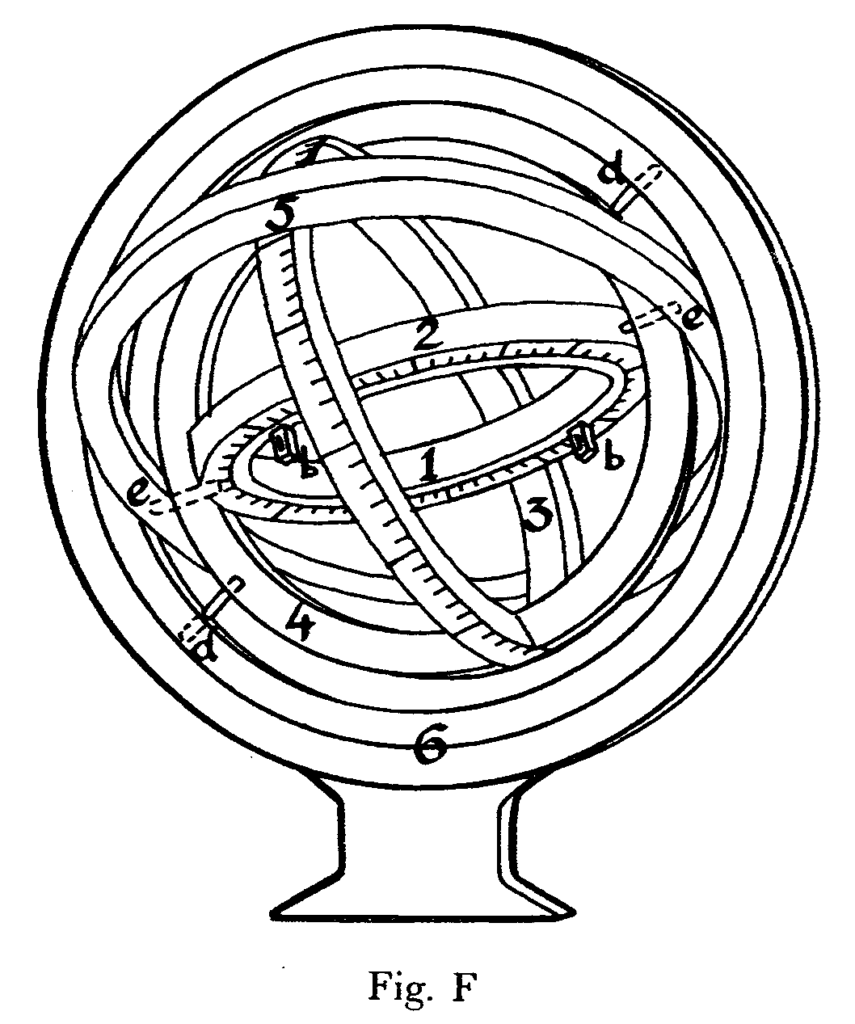
figure adopted from: G. J. Toomer. Ptolemy’s Almagest. P. 218
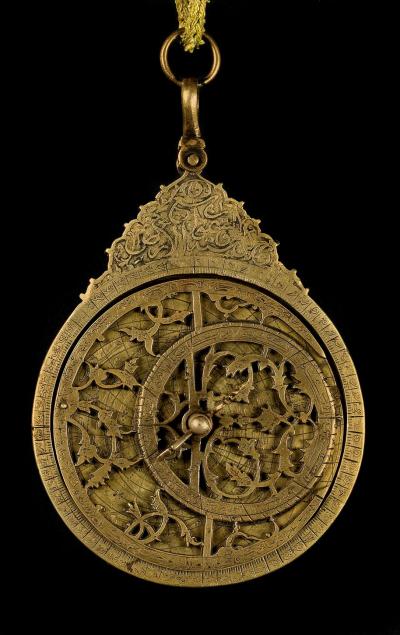
The instrument could be used to observe celestial objects and determine their longitude and latitude based on the calibration of the rings. Later, Ptolemy wrote an independent treatise describing a revised version of this instrument with nine rings. Ptolemy also wrote a treatise on projecting the celestial circles on a plane which is the foundation of construction of regular plane stereographic astrolabe.
Ptolemy’s Almagest also contains the earliest star catalogue that reached us in its entirety. He listed 1025 stars (his list includes also some deep-sky objects visible with the naked eyes).
Ptolemy’s Almagest was one of the most influential astronomical works in ancient and medieval astronomy. It was translated several times from Greek to Arabic, and many revisions of it were produced in different oriental languages. The name by which it is known today originated from the Arabized version of part of its original title. Its content was discussed and critically examined in hundreds of works
This report represents how al-Maʾmūn was interested in astronomy. He commissioned many Greek mathematical and astronomical works to be translated into Arabic, many of which reached us today in the form of a manuscript. These translations constitute the core material needed to establish a new scientific tradition.
Ptolemy’s Other Works
Besides some minor works, Ptolemy wrote two more important astronomical works known by the titles Handy Tables and Planetary Hypotheses. The Handy Tables was a collection of astronomical tables largely adopted from the Almagest, improved in some cases from empirical and practical calculational perspectives. In the Planetary Hypotheses, Ptolemy presented a summary of the main results of the Almagest without proof for those who wish to gain a general picture of the heavens and their motions. In the Planetary Hypotheses, Ptolemy seeks to offer a coherent and unified account of astronomy by investigating planetary sizes and distances, and discussing the nature of celestial bodies. Ptolemy also wrote the Tetrabiblos on astrology, the Geography on the cartography and geography, the Optics on geometrical optics, and the Harmonics on music theory.
This article is contributed by Sajjad Nikfahm Khubravan