Stars and Their Names
The names of constellations and stars are a reflection of the contributions made by different cultures to science throughout the centuries. Today’s star names are derived from a variety of past cultures and languages, mainly from the Middle East and the Mediterranean region. Since medieval times, these names have been mixed together and passed down to us in Latin characters. Paul Kunitzsch was a prominent historian of science who investigated the names of stars in Greek, Arabic, Persian, Hebrew, Latin, and other sources in several of his studies. In one of these studies, coauthored with Tim Smart, Kunitzsch used statistical analysis of 254 names to show that 70% of star names originated from Arabic, and 19% from Greek or Latin. A few names also come from Persian, Hebrew, Turkish, English, and old Mesopotamian sources. In the following diagram, Kunitzsch illustrates the interaction of these cultures during different historical periods to create the names of stars as we know them today.e
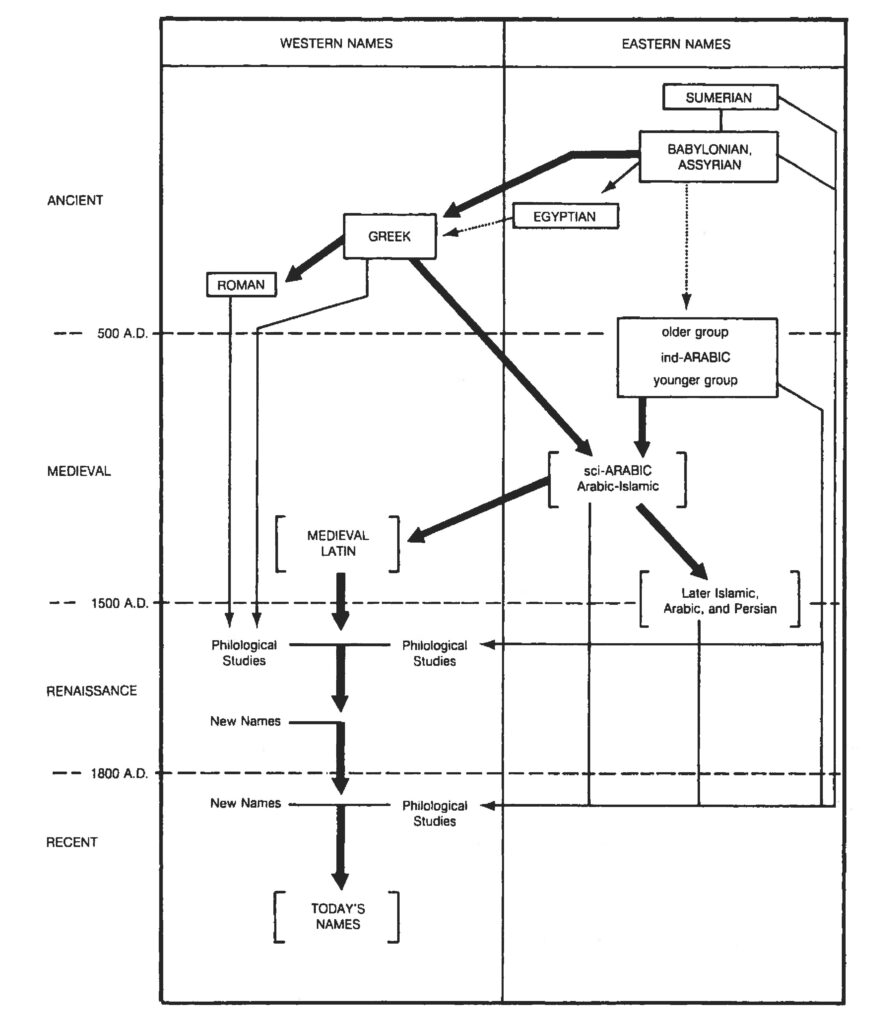
Source: Kunitzsch and Smart. A Dictionary of Modern Star Names, p. 5
The two links below will take you to a list of stars with their original Arabic and Greek names. For further information see: Paul Kunitzsch and Tim Smart. A Dictionary of Modern Star Names, a Short Guide to 254 Star Names and Their Derivations (Cambridge, Massachusetts: Sky Publishing, 2006).